Best Packing Cubes: The Set That Survives 100 Trips, and the Ones That Split on Trip 4
Verdict:For most travelers, the Eagle Creek Pack-It Reveal Cube Set is the pick, because the mesh windows let you find things without unpacking and the lifetime warranty covers the one part that fails, the zipper. If you are trying to fit ten days into a carry-on, skip the mesh sets and buy a compression cube instead.
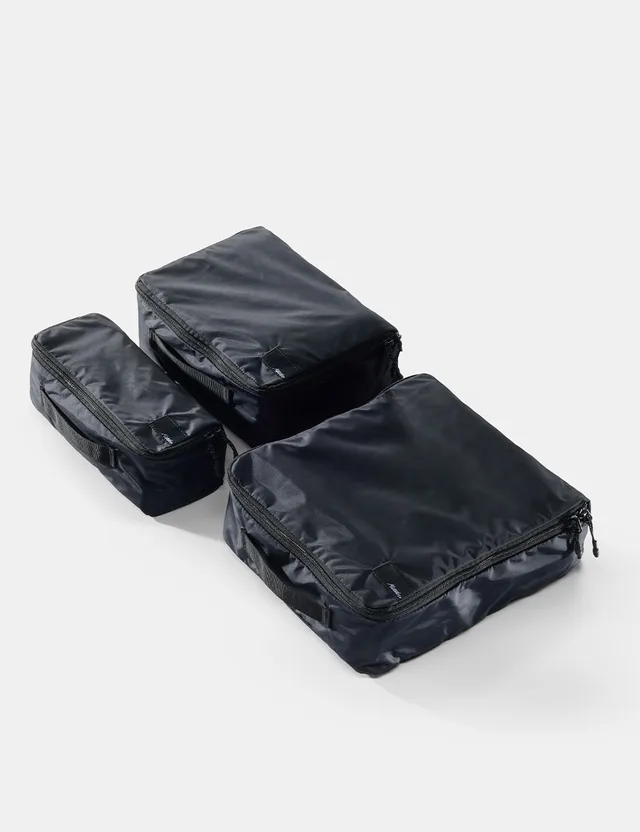
For most travelers, the Eagle Creek Pack-It Reveal Cube Set is the packing cube set to buy, because the mesh windows let you see what is inside without unzipping, and the “No Matter What” lifetime warranty covers the one part on any cube that eventually fails, the zipper. If you are trying to squeeze ten days of clothes into a carry-on, skip every mesh set here, because they organize your bag without shrinking it, and buy a compression cube instead.
Here is the honest truth about packing cubes that most roundups skip. They do not create space. A mesh cube keeps your shirts in one block instead of scattered, which makes packing faster and unpacking cleaner. Only a compression cube, with a second zipper that squeezes out air, actually makes your pile smaller. Both are useful. They solve different problems, and buying the wrong one is the most common mistake.
Some links in this article are affiliate links. If you buy through them, we earn a small commission at no extra cost to you. We only link to products we would actually recommend. If it does not hold up in real use, it is not here.
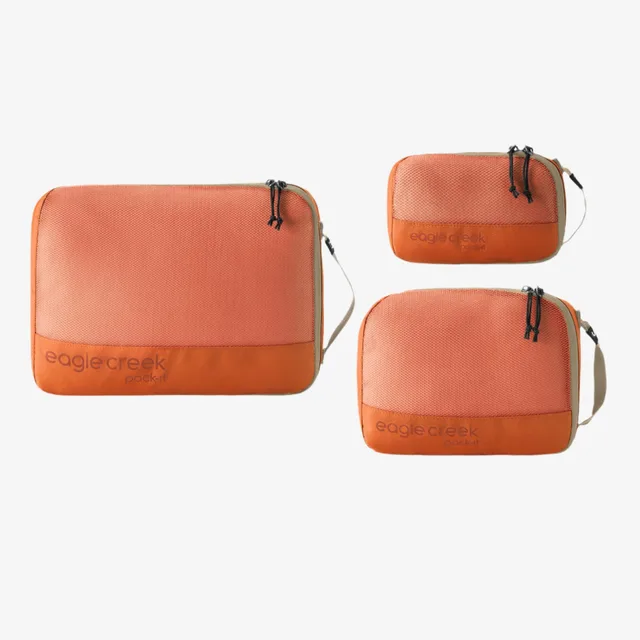
This is the set to buy if you want organization, not compression. The Reveal set lists at $59, and Eagle Creek runs it on sale often, near $35 at the time of writing in July 2026. You get three cubes in extra-small, small, and medium, which stack flat in a carry-on. The front of each cube is a tight mesh panel, so you find your socks by looking, not by opening three cubes at the gate. The fabric is 100 percent recycled and water-resistant. Pack Hacker tested the Reveal set hands-on and reported “no abrasions or holes, and we haven’t noticed any loose threads.”
The reason this set wins is the warranty. Eagle Creek’s “No Matter What” lifetime warranty covers the exact failure that ends most packing cubes. One REI buyer reported that on a cheaper cube “the zipper split and then came completely undone” on the fourth use. When an Eagle Creek zipper fails, you send it back and get a replacement, which is the difference between a $59 set that lasts a decade and a $20 set you rebuy every year.
The honest negative is the mesh itself. That open front lets air move, which is the point for damp gym clothes, but it also means smells and dampness escape into the rest of your bag. One REI reviewer had the mesh “tear in two places the first time” on a lower-end cube, so treat the mesh as the part to protect. If your packing list includes wet swimwear, put it in a separate dry bag, not a mesh cube.
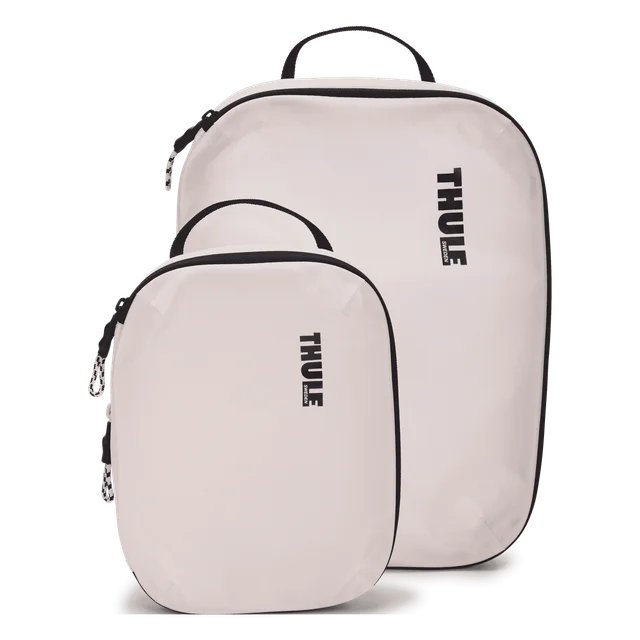
If you actually need more room, this is the set. The Thule Compression set costs $53.95 and does the one thing mesh cubes cannot. The small cube packs at 10.2 by 7.1 by 4.3 inches (26 by 18 by 11 cm), then a second zipper pulls it down to 1.25 inches deep (3 cm). That is a real reduction, not a marketing number. GearJunkie’s testers fit ten pairs of boxer briefs, ten days of underwear, into the small cube after compression. The shell is 100D ripstop nylon, the whole small cube weighs 0.46 lb (209 grams), and the zippers are YKK, which matters because the compression zipper takes the most stress.
One REI buyer ran two of these through a three-month backpacking trip and reported “no zipper splits, no tears, and no problem compressing heavy loads.” That is the durability bar a compression cube has to clear, because the compression zipper is where these fail.
The honest negative is that same zipper. With a full cube, the compression zip “is harder to close” and needs two hands. Compression cubes across every brand share one failure mode: the fabric catches under the second zipper and abrades. On the Rick Steves travel forum, a poster named Trotter described “the 2nd zipper snag so badly on the cube that the cube’s fabric tore.” Close the compression zipper slowly and keep fabric clear of the teeth. There is also no internal organization inside, so this is a stuff-and-squeeze cube, not a sort-your-outfits cube.
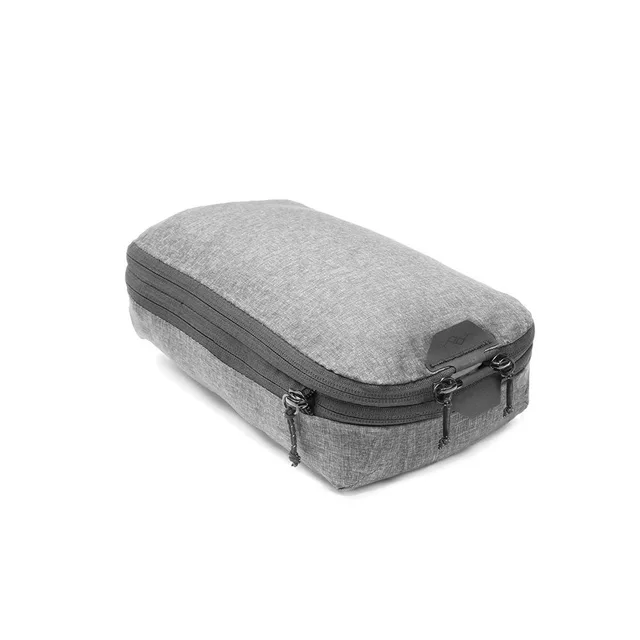
The Peak Design cube is the one to buy if you want structure and you are hard on your gear. Peak Design sells these as single cubes, not a set: the Small is $29.95 and the Medium is $39.95. The shell is a 70D recycled ripstop called Versa Heal, and the name is not just branding. Small punctures close under finger pressure, so a snag from a zipper or a shoe heel does not spread into a tear the way it does on thinner cubes. An expansion and compression zipper lets you add space on the way out or squeeze contents down for the trip home. Zappos owner reviews run 89 percent five-star across 255 ratings, with one buyer noting they “packed for three weeks using only a smaller carry on.”
The honest negative is the price against the risk of its own design. Pack Hacker ran these for two months and warned that “we have had the stretchy mesh part get caught on the compression zipper,” which “could also affect the zipper itself” over time. That is the same catch-and-abrade problem every compression cube has, and here you are paying single-cube prices to get it: a full three-piece set runs over $100. Most buyers, in Pack Hacker’s words, find it “hard to justify spending $70 on packing cubes.” Buy these if you already trust Peak Design and want the self-healing shell. Skip them if you need a full set on a fixed spend.
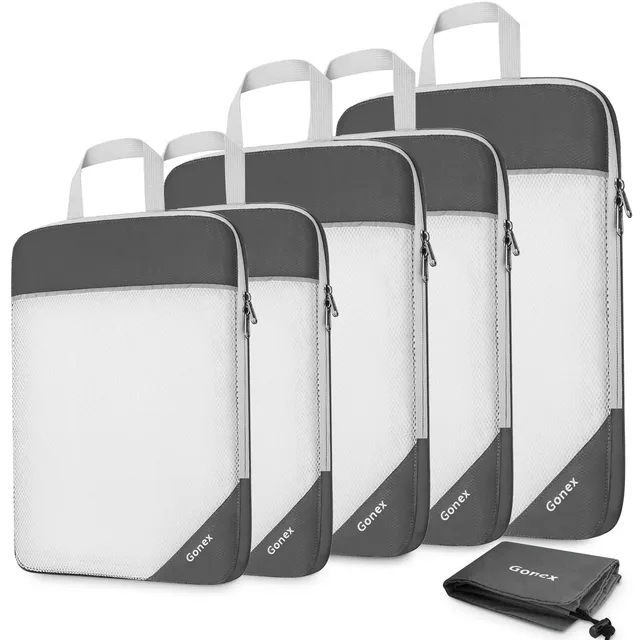
The Gonex set is the compression pick when you will not spend $54 on Thule. A set runs about $31.99 for a ripstop polyester set with the same double-zip compression design as the pricier cubes. These “open up all the way like a regular packing cube, just with a second zip for compression,” in the words of the Happy to Wander tester who used them for six months, and they come in more sizes and colors than Eagle Creek.
There are two honest negatives, and together they explain the price gap. First, durability. Pack Hacker found “the fabric tends to get caught in the compression zipper as you’re zipping it up,” which “makes us concerned about longevity,” and judged the ripstop shell too thin to stop a tear from spreading. Second, and this is the one people miss, the Gonex cubes “don’t compress as well as the Eagle Creek ones, and they’re also a bit heavier.” A compression cube that adds weight while removing less air is working against its own purpose. Buy these to try compression cheaply. If you travel weekly, the Thule set will outlast two or three Gonex sets.
For one-bag travelers counting grams, the Matador set is the answer. It costs $35 for a three-pack, and the individual pieces weigh as little as 44 grams (1.6 oz), so the cubes themselves barely register against your baggage limit. The zippers are YKK, and Pack Hacker reported the “incredibly lightweight materials retain durability” and “held up well” under heavy loads, which is the concern with any cube this thin.
The honest negative is that the compression only works when the cube is full. Pack Hacker found “the compression straps aren’t as helpful when the cubes aren’t at capacity,” so a half-empty Matador cube collapses into a floppy shape instead of a neat block. There is no internal organization, and you cannot buy the sizes separately, so you take the three-piece set as-is. Buy these if every gram counts and you pack them full. Skip them if you want structured cubes that hold their shape half-empty.
Compression cubes squeeze out air, not weight. Your ten shirts weigh the same compressed as loose. On the Rick Steves travel forum, a poster who bought compression cubes described the trap directly: “I had more space in my luggage, so I added more, and eventually my bag became heavier.” If your airline enforces a weight limit, not just a size limit, a compression cube can push you over it by tempting you to fill the space you just freed. The cube shrinks your pile. It does not shrink the scale reading, and it will not stop you from overpacking.
The decision
If you want to find things without unpacking, buy the Eagle Creek Pack-It Reveal Cube Set. Mesh windows plus a lifetime warranty on the zipper, at a $59 list that is often on sale near $35.
If you need to fit more into a fixed carry-on, buy the Thule Compression set. A real drop from 4.3 inches to 1.25 inches deep on YKK zippers, for $53.95.
If you are hard on your gear and want self-healing fabric, buy the Peak Design Packing Cube. The Versa Heal shell resists spreading tears, at $29.95 small or $39.95 medium per single cube.
If you want to try compression cheaply, buy the Gonex set. Around $31.99 and the same double-zip design, as long as you accept thinner fabric and slightly less compression than Thule.
If you count grams for one-bag travel, buy the Matador set. A 44-gram-per-piece three-pack for $35, as long as you pack each cube full so the compression works.
The best luggage tracker for Android depends on your phone brand and where you fly. Samsung users pick one tracker, everyone else another. Here is the split.
Verdict: If you carry a Samsung Galaxy phone, the Galaxy SmartTag2 is the pick, because it rides the densest Android tracker network you can access. On any other Android phone, buy a Google Find My Device tracker like the Chipolo ONE Point. Skip all of them if you expected AirTag-on-iPhone reliability, because no Android tracker matches that yet.
Noise cancelling headphones for long flights, ranked by how they kill engine drone over 10+ hours. The pick, the price, and who should skip each pair.
Verdict: For most long-haul flyers, the Bose QuietComfort Ultra Headphones are the pick, because they mute engine drone as well as anything and stay comfortable past hour eight. If you sleep on your side against the window, skip every over-ear pair here and use earbuds.
The best eSIM for Europe, ranked by price per GB, country coverage, and real throttling limits. The pick, the price, and who should skip each one.
Verdict: For most trips across several European countries, Nomad's Europe regional plan is the pick, because 10 GB for 30 days costs $23 and works in 35 countries on one eSIM. If you burn through more than a few GB a day and never want to think about a data cap, skip the metered plans and buy Holafly unlimited instead, at $73.90 for 30 days.