Best Power Bank for International Travel: The Watt-Hour Math Airlines Actually Check
Verdict:For most international flyers, the Anker 737 Power Bank (24,000 mAh, 88.8Wh) is the pick, because it charges a laptop at 140W and stays comfortably under the 100Wh line every airline enforces. If you carry only a phone, skip the 630-gram bricks and buy the 231-gram Anker Nano instead.
For most people flying internationally, the Anker 737 Power Bank (24,000 mAh, 88.8Wh) is the power bank to buy, because it charges a laptop at 140W and stays under the 100-watt-hour line that every airline in this article enforces. If you only ever charge a phone, skip the 630-gram bricks here and buy the 231-gram Anker Nano instead, because you will resent the weight of a laptop bank you never use at full capacity.
The number that decides whether a power bank flies is not milliamp-hours. It is watt-hours. Airlines regulate lithium batteries by Wh, and the formula is simple: Wh = (mAh × V) ÷ 1000, at the 3.7V nominal voltage most cells use. A 20,000 mAh bank is about 74Wh. A 27,000 mAh bank sits right at 100Wh, which is the carry-on ceiling on most carriers. Anything larger is a problem before you reach the gate.
Some links in this article are affiliate links. If you buy through them, we earn a small commission at no extra cost to you. We only link to products we would actually recommend. If it does not hold up in real use, it is not here.
The rule that comes first: watt-hours and your specific airline
Power banks must fly in your carry-on, never in checked luggage, on every airline listed here. Under 100Wh needs no approval. Between 100Wh and 160Wh you need airline permission, usually limited to two. Over 160Wh is banned from passenger flights entirely.
The limits below are current as of 2026, and they vary enough that you must check yours before you pack:
United allows power banks under 100Wh in the cabin, but as of March 1, 2026 they must stay accessible in the seat pocket or under the seat, not in the overhead bin.
American and Delta follow the standard under-100Wh rule and, as of May 1, 2026, limit you to two portable chargers per passenger.
Southwest allows one power bank per passenger as of April 20, 2026.
Lufthansa Group (SWISS, Austrian, Brussels, Eurowings, ITA) allows a maximum of two under-100Wh banks, stored under the seat, with in-flight use banned.
Emirates allows one bank under 100Wh and prohibits using it during the flight.
Singapore Airlines and Scoot allow under-100Wh banks and require approval for the 100 to 160Wh range.
Japanese carriers allow up to two banks under 160Wh as of April 2026, but prohibit charging them from in-seat USB ports or outlets.
One rule now applies almost everywhere. Under the IATA Dangerous Goods Regulations 67th edition, effective January 1, 2026, charging a power bank from an in-seat USB port or outlet is prohibited in flight. Charge your devices from the bank, not the bank from the plane.
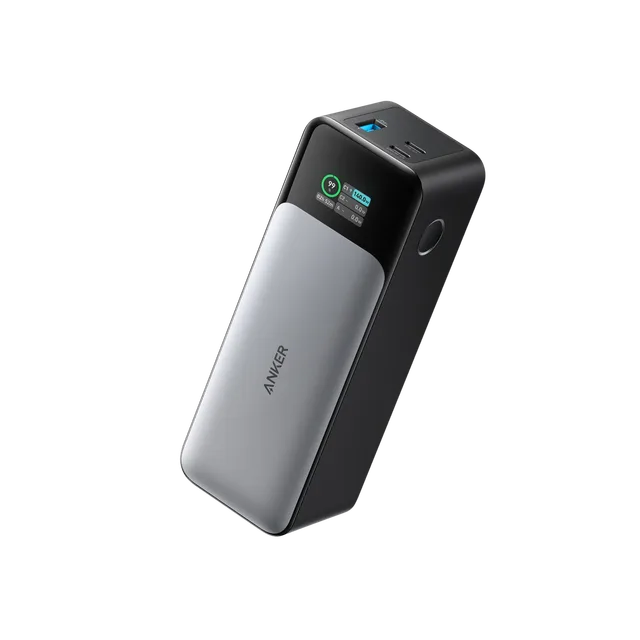
This is the bank to beat for international travel because it does the hard job, charging a laptop, without crossing the airline line. It holds 24,000 mAh, which works out to 88.8Wh (24,000 × 3.7 ÷ 1000), a clear 11Wh under the 100Wh ceiling United, American, Delta, and the Lufthansa Group all enforce. You will not be asked to prove anything at security.
The output is where it earns the price. It pushes 140W through USB-C, enough to charge a MacBook Pro at close to wall-adapter speed, and it carries two USB-C ports plus one USB-A for a phone or earbuds at the same time. A small screen shows exact remaining charge, so you are not guessing on a layover.
The honest negative is weight. At 630 grams (22.22 oz) it is a genuine brick, and one-bag travelers on Reddit’s r/onebag score it at 0.85 grams per watt-hour, worse than an ultralight bank. If your bag weight is fixed by a budget carrier’s cabin allowance, that 630 grams is 630 grams you are not spending on anything else. It costs $109.99.
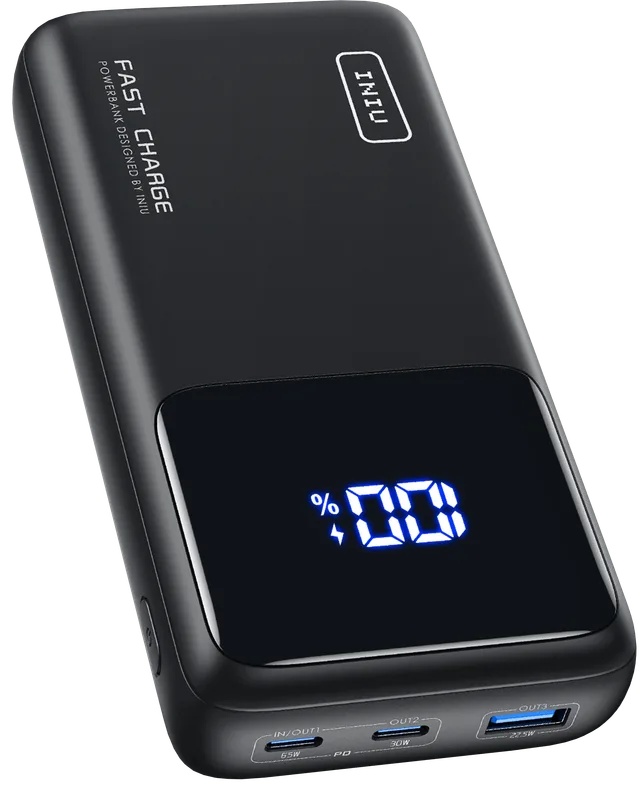
The INIU B63 is the pick if you want laptop charging without paying laptop-bank prices. It holds 25,000 mAh, which is 92.5Wh (25,000 × 3.7 ÷ 1000), still safely under the 100Wh line. It puts out 100W over USB-C, less than the Anker 737’s 140W but enough to charge most 13-inch and 14-inch laptops at a usable rate, and it drives three devices at once across two USB-C ports and one USB-A. At $59.99 it undercuts the Anker 737 by fifty dollars and ships with a three-year warranty.
The honest negative is the track record. INIU is a value brand, so there is less independent long-term reliability data than there is for Anker, and if a cell degrades in year two you are relying on that warranty rather than a deep repair network. It is also still a 581-gram (20.5 oz) brick, so it solves the price problem, not the weight problem.
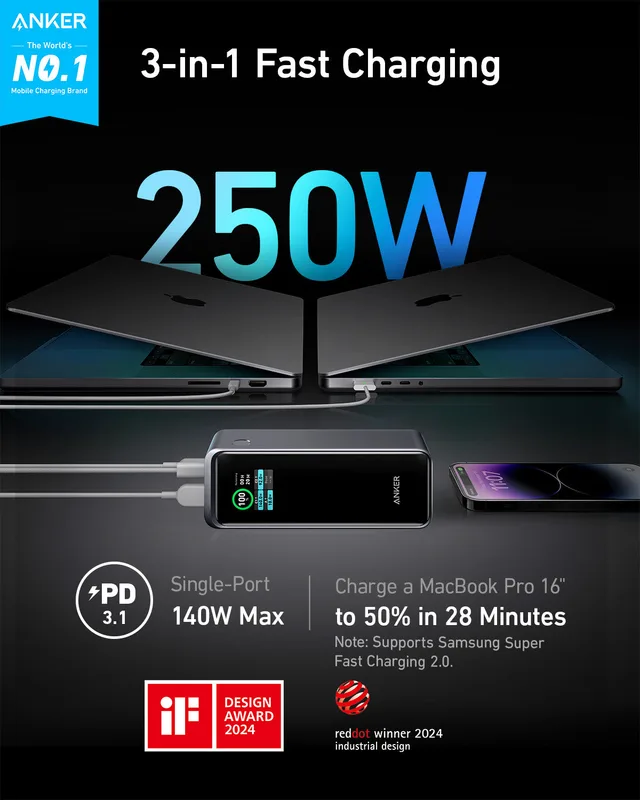
The Anker Prime is the pick for the traveler charging a laptop, a phone, and a tablet on the same leg, but it comes with a caveat you need to understand. It holds 27,650 mAh. At the plain 3.7V formula that computes to 102Wh, which would put it over the limit. Anker officially rates it at 99.54Wh using a lower nominal voltage, and that 99.54Wh figure is what keeps it legal for carry-on. It sits right at the ceiling.
The output is the most in this roundup: 250W total across two USB-C ports and one USB-A, enough to fast-charge two laptops and a phone together. If you travel with a full mobile office, nothing here keeps up like it does.
The negatives are real. At 665 grams (23.4 oz) it is the heaviest bank on this list, roughly the size and weight of a full soda can. And because it is the model that sits closest to 100Wh, it is the one most likely to draw a second look from a gate agent counting watt-hours, even though 99.54Wh is compliant. It was showing as sold out at Anker at the time of writing and historically prices around $179.99, so confirm the current price and stock on Anker’s page before you count on it.
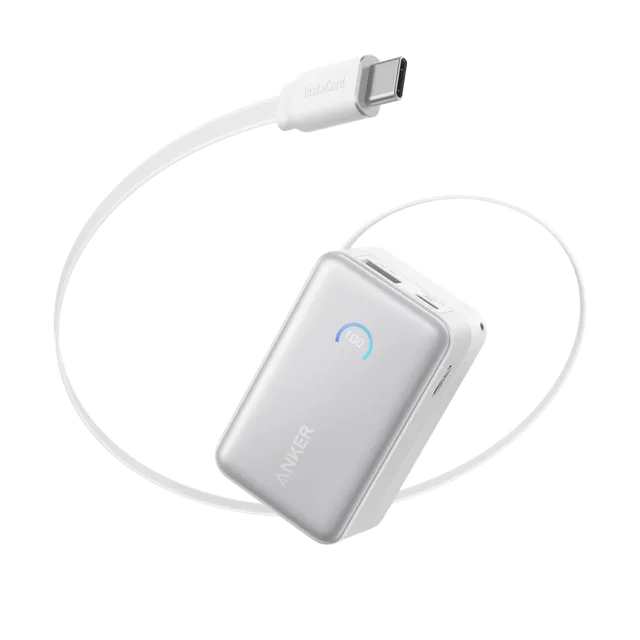
The Anker Nano is the everyday-carry pick for a traveler who charges a phone, not a laptop. It holds 10,000 mAh, which is 37Wh (10,000 × 3.7 ÷ 1000), so far under the 100Wh limit it is a non-issue on any airline. It weighs 231 grams (8.2 oz), roughly a third of the laptop bricks, and it has a retractable USB-C cable built into the body, so you are not digging for a loose cable at the gate. It also carries a separate USB-C port and a USB-A, and it costs $59.99.
The honest negative is capacity. 10,000 mAh tops up a modern phone about twice, which covers a long-haul day but not a laptop, and its 45W output will not fast-charge a larger laptop under load. Buy it to keep a phone alive across a travel day, not to run a work setup.
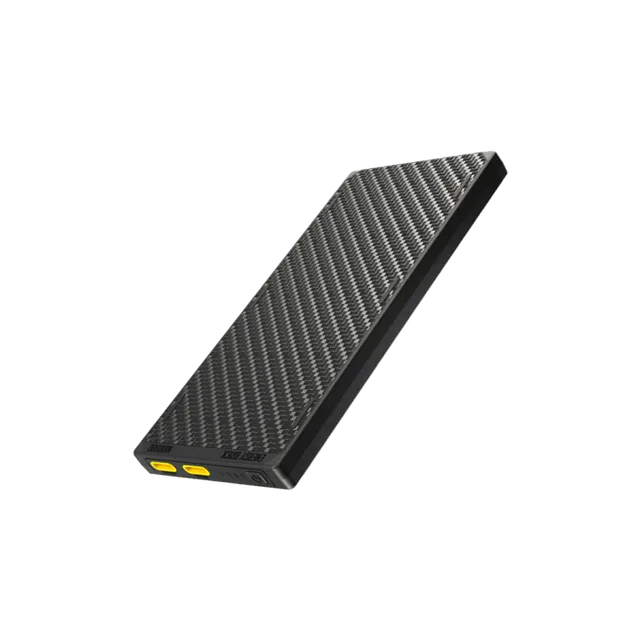
The Nitecore NB10000 Gen 3 is the pick for anyone counting grams, which means backpackers and dedicated one-bag travelers. It holds 10,000 mAh, rated by Nitecore at 38.5Wh, and its carbon-fiber body weighs just 150 grams (5.29 oz). That is about 0.72 grams per watt-hour, the best ratio in this roundup and the reason it is the consistent favorite on r/onebag and r/Ultralight. It runs dual USB-C ports at up to 22.5W.
Two honest negatives, both from CleverHiker’s testing. It recharges slowly, taking 4 hours 9 minutes from empty, longer than most 10,000 mAh banks they measured, so plan to top it up overnight rather than during a short stop. It also lost 8.9 percent of its capacity in cold-weather testing, the worst drop in their group, which matters if you are charging in genuinely cold conditions. Note too that Nitecore lists this Gen 3 as discontinued in favor of its newer Carbo line, so if the price has climbed as stock runs down, compare it against the current Carbo model on Nitecore’s own page before buying. Nitecore does not list a price on the product page; it has typically sold around $59.95.
If you want one bank that covers a laptop and clears every airline, buy the Anker 737. 88.8Wh under the 100Wh line, 140W USB-C, for $109.99.
If you want laptop charging for less money, buy the INIU B63. 92.5Wh, 100W, and a three-year warranty for $59.99, as long as you accept a value brand’s shorter track record.
If you charge a full mobile office at once, consider the Anker Prime. 250W across three ports, but at 665 grams and 99.54Wh it is the heaviest bank here and the one closest to the airline ceiling, historically around $179.99.
If you only ever charge a phone, buy the Anker Nano. 37Wh, 231 grams, built-in cable, for $59.99, which is the right size for a device that does not need a laptop bank.
If you count every gram on the trail, buy the Nitecore NB10000 Gen 3. 150 grams and 38.5Wh at about 0.72 grams per watt-hour, typically around $59.95, as long as you can live with a 4-hour recharge and a cold-weather capacity hit.
The best packing cubes, ranked by what actually breaks: zippers, mesh, and compression. The pick, the price, and who should skip each set.
Verdict: For most travelers, the Eagle Creek Pack-It Reveal Cube Set is the pick, because the mesh windows let you find things without unpacking and the lifetime warranty covers the one part that fails, the zipper. If you are trying to fit ten days into a carry-on, skip the mesh sets and buy a compression cube instead.
The best luggage tracker for Android depends on your phone brand and where you fly. Samsung users pick one tracker, everyone else another. Here is the split.
Verdict: If you carry a Samsung Galaxy phone, the Galaxy SmartTag2 is the pick, because it rides the densest Android tracker network you can access. On any other Android phone, buy a Google Find My Device tracker like the Chipolo ONE Point. Skip all of them if you expected AirTag-on-iPhone reliability, because no Android tracker matches that yet.
Noise cancelling headphones for long flights, ranked by how they kill engine drone over 10+ hours. The pick, the price, and who should skip each pair.
Verdict: For most long-haul flyers, the Bose QuietComfort Ultra Headphones are the pick, because they mute engine drone as well as anything and stay comfortable past hour eight. If you sleep on your side against the window, skip every over-ear pair here and use earbuds.