Verdict:The Peak Design Travel Tripod Aluminum ($379.95) is the compact tripod to buy if you want full-size stability in a carry-on-friendly footprint. At 15.4" collapsed and 60" max height, it is the only tripod in its class that genuinely fits in a bag without compromise. The Carbon Fiber version ($599.95) saves 0.63 lbs at a $220 premium — worth it for ultralight backpacking trips, not necessary for most travelers.
The problem with most travel tripods is the same one that affects every category of travel gear designed to be “small enough.” They compromise in ways that matter — too short to shoot at eye level, too lightweight to hold a camera steady in wind, too proprietary in their head system to work with lenses you already own. You spend $80 on a travel tripod, take it on one trip, and it spends the next year in a closet.
The Peak Design Travel Tripod is a different decision. At $379.95 for aluminum and $599.95 for carbon fiber, it is not a budget buy. But it is the tripod that serious photographers pack without thinking twice about whether it will actually be useful when they get there.
Some links in this article may be affiliate links. We only recommend gear we’d bring on our own trips.
What makes it different from other travel tripods
Most compact tripods make themselves small by removing height. The Peak Design Travel Tripod reaches 60 inches at maximum height with the center column extended. Without the column, it reaches 52.7 inches — enough for most shooting positions without bending over.
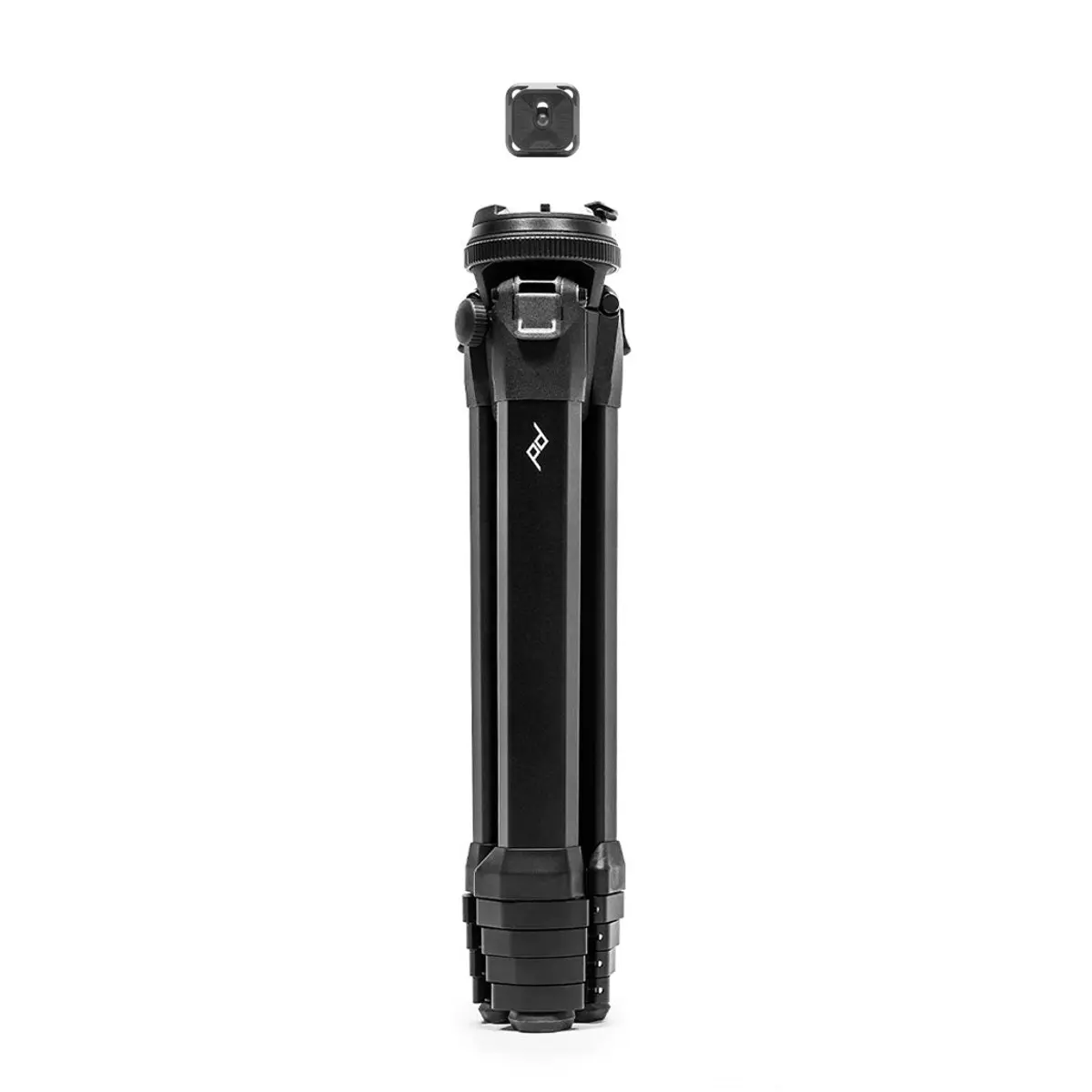
The collapsed length is 15.4 inches. For context, a standard 1-liter Nalgene bottle is 11 inches tall. This tripod fits in the side pocket of a larger pack or stands upright in a bag’s main compartment without sticking out. That is the design trick Peak Design engineered over four years: five-section legs that store legs-inward (toward the center column rather than outward), reducing the collapsed diameter to 3.125 inches without reducing the maximum height.
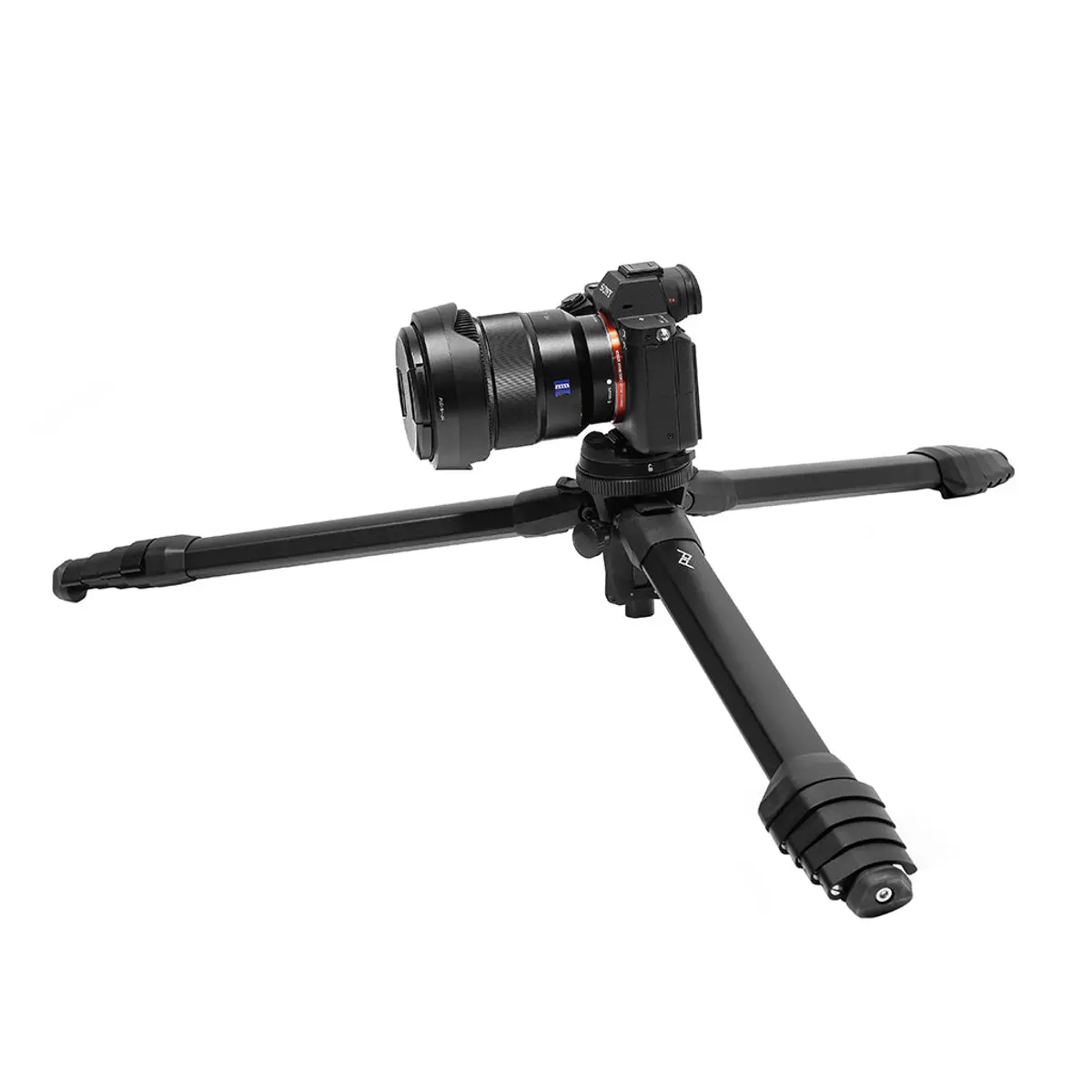
The ball head is integrated — no separate head to buy, carry, or lose. It uses Peak Design’s Arca Swiss-compatible capture plate system, which means existing Peak Design camera clips and straps attach directly. For photographers already in the Peak Design ecosystem, setup time drops to a few seconds.
Load capacity is listed at 20 lbs. In practical terms, that handles a full-frame camera body with any realistic travel lens, including 70-200mm zooms.
Aluminum vs. Carbon Fiber: which version to buy
Aluminum
Carbon Fiber
Price
$379.95
$599.95
Weight
3.44 lbs
2.81 lbs
Weight savings
—
0.63 lbs
Collapsed length
15.4”
15.4”
Max height
60”
60”
Load capacity
20 lbs
20 lbs
Best for
Most travelers
Ultralight backpacking
The specs are identical except weight. Carbon fiber saves 0.63 lbs at a $220 premium. For most travelers, that trade-off does not work out. For ultralight hikers who count grams and are already spending $600+ on a camera, the carbon version makes sense.
Both versions include the same ball head, leg locks, center column with hook, and carrying strap. The lifetime warranty covers both.
If you are deciding between aluminum and putting the $220 toward a better lens or a longer trip, choose aluminum.
Key features that matter in travel use
Five-section legs with simultaneous release. Each leg has five sections and all five locks can be released at once by gripping and twisting the leg. Deployment from collapsed to shooting-ready takes about 20 seconds once you have practiced it. That is faster than most legs-extend-then-twist-to-lock systems.
Low mode. Minimum height is 5.6 inches, reached by inverting the center column and spreading the legs to their maximum angle. Macro and ground-level shots are easy without any adapter. The low angle is stable enough for long exposures.
Integrated ball head with separate pan lock. The ball head has two controls: a tension/lock knob for the ball itself, and a separate pan lock for smooth horizontal panning without loosening the ball. For video panning, this matters. Most integrated tripod heads combine these into one knob.
Load hook. The bottom of the center column has a hook for hanging a bag or weight to increase stability in wind. A bag of camera gear hanging from this hook significantly reduces sway in open outdoor conditions.
Carrying strap. A cross-body strap attaches to two points on the folded tripod. Carrying it over one shoulder leaves both hands free during hikes and city walks. It is a small thing that makes a daily-use difference.
You travel with a camera more than twice a year and want one tripod that handles any situation
You are already using Peak Design straps or clips (the system integration is genuine value)
You need a tripod that fits in carry-on without using most of the bag’s volume
You shoot long exposures, astrophotography, or timelapse on trips
Skip it if:
You shoot casually with your phone or a point-and-shoot — a smaller, cheaper phone tripod adapter does the job
You need a tripod over 6 feet tall for eye-level shooting — this tops out at 60 inches, below eye level for taller photographers without the center column
Your budget is under $200 — there are capable tripods in that range that make real trade-offs worth understanding
Weight note for tall photographers. At 5’10” and under, maximum height without the column is workable for most shooting. Above 6 feet, the center column will be in regular use, which introduces more vibration risk in windy conditions. Not a dealbreaker, but worth knowing.
What to pair with it
If you use Peak Design camera clips and straps, the Travel Tripod accepts the same capture plates. No adapter required. The Dual Plate attaches to the base of the camera and clicks into both the tripod head and any Peak Design clip.
For smartphones, Peak Design makes a dedicated phone tripod mount that attaches to the ball head and adjusts for any phone size. It is an add-on purchase but integrates cleanly.
For carrying, the included strap handles most situations. A small travel camera bag that positions the tripod externally (sleeve along the side or back attachment) keeps the tripod accessible without adding bag bulk.
The common comparison point is a $60 to $120 travel tripod — smaller, lighter on spec sheets, and available at most camera shops. Here is what those trade-offs look like in practice:
Most $80 travel tripods top out at 54 to 57 inches with the center column extended. They weigh 2.5 to 3 lbs — not much less than the Peak Design aluminum. Their load ratings are stated at 10 to 15 lbs, which is workable for most mirrorless cameras but cuts off the larger zoom lenses. Ball heads on budget travel tripods are functional but lack the separate pan lock, making video panning harder.
The Peak Design earns its price primarily through two things: the collapsed footprint (genuinely smaller than most alternatives at the same max height) and the ecosystem integration. If neither of those matters for your shooting, a $100 travel tripod does real work.
FAQ
Is the Peak Design Travel Tripod worth it?
For photographers who travel more than occasionally and care about image quality in low light, yes. The combination of carry-on-compatible size and full-size stability is not matched by anything close to the price. For casual travelers, the price is hard to justify.
Can the Peak Design Travel Tripod fit in a carry-on?
Yes. At 15.4 inches collapsed and 3.125 inches in diameter, it fits in a carry-on bag alongside camera gear and travel essentials. It does not require checking a bag or external mounting. Most photographers carry it upright in the main compartment or in a side sleeve.
Is aluminum or carbon fiber better for travel?
Aluminum is the better value for most travelers. The 0.63 lb weight difference between aluminum (3.44 lbs) and carbon fiber (2.81 lbs) is real but not significant enough to change how you pack. The $220 price difference is significant. Choose carbon fiber if you are ultralighting a serious hiking or backpacking photography trip where every gram is budgeted.
Does it work with older cameras without Peak Design clips?
Yes. The ball head has a standard 1/4”-20 screw mount in addition to the capture plate system. Any camera with a standard tripod socket attaches directly. The Peak Design plate system adds convenience for photographers already in the ecosystem, but it is not required.
How does it compare to the Joby GorillaPod for travel?
Different tools. The GorillaPod wraps around objects and works on uneven surfaces — useful for creative angles and surfaces where a traditional tripod cannot stand. The Peak Design Travel Tripod provides traditional-tripod stability at full height. Most serious photographers who travel with a camera will find a use for both, but they are not interchangeable.
Final thoughts: the math on a travel tripod
The Peak Design Travel Tripod asks you to spend more than you expected to spend on a tripod. The case for it is simple: a tripod you leave at home because it is too bulky or too annoying to pack is worth nothing. A tripod that fits in your carry-on and reaches 60 inches without compromise goes on every trip.
If you have been skipping shots because you did not have stable support — or leaving your tripod home because you did not want to check a bag — the Peak Design Travel Tripod solves that problem. The aluminum version at $379.95 is where to start.
Sources for this review (verify, then delete or convert to inline links):
eSIM wins for multi-country trips and modern phones. Physical SIM still beats it for long single-country stays and older devices. Here's how to decide.
Verdict: For most travelers on modern phones doing multi-country or short-stay trips, an eSIM from Airalo or Saily is the right call — it activates before you land and costs $4–$20 for regional coverage. Physical SIM still wins if you're staying in one country for weeks, using an older device, or want calls and texts included in your plan.
The Arzopa A1 is the portable monitor most travelers should buy. Three picks by budget: $79 solo screen to $399 dual-display.
Verdict: The Arzopa A1 ($79.99) is the portable monitor most travelers should start with — 1.6 lbs, USB-C powered, and plug-and-play with any modern laptop. Step up to the ViewSonic VX1655 ($159.99) if you want better build quality and 60W pass-through charging. Remote workers who genuinely need two screens should look at the JSAUX FlipGo Standard.
The Pelican Marine Floating Pouch is the best waterproof phone case for most travelers. Three picks from $10 budget to $20 floating protection.
Verdict: The Pelican Marine Floating Pouch ($20) is the right pick for most travelers — IP68 rated, floats if dropped in water, fits any phone up to 6.7", and includes a detachable lanyard. For budget travelers who just want splash protection, the JOTO Universal Pouch covers the basics at under $13. Snorkelers and underwater photographers need a hard waterproof case, not a pouch.